

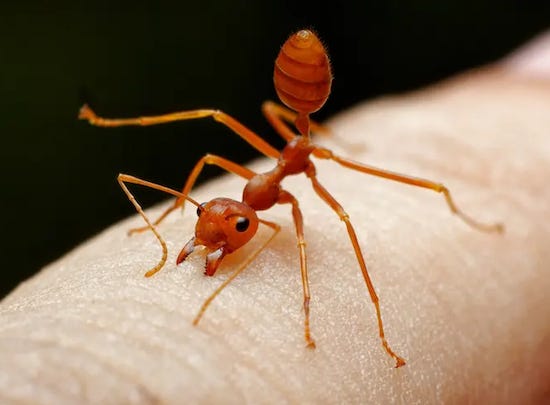
A week after moving to Austin, I pulled into a side road to take a phone call from my accountant. As it wasn’t eleventy-billion degrees outside, yet, I got out of my SUV to finish the call. I felt something tickling my right foot.
Ants were ambling around my sandal straps. I lifted up my foot and brushed a couple off. Wrong answer. Fire ants aren’t called fire ants because they’re the bane of Smokey the Bear’s existence.
Simply put, a fire ant bite lights your flesh on fire. A sharp burning pain that doesn’t quit for an hour or more, leaving behind small, puss-filled blisters as itchy as a mosquito bite.
But wait! There’s more!

When a fire ant bites, it releases a pheromone that alerts nearby ants to join in the attack. So all the ants on my foot sunk their stingers into my epidermis at the same time.
I must have looked ridiculous, hopping on one foot, scraping ants off my foot like they were hot embers. Which they more or less were.
I’m glad there weren’t any police cars on my route to the drug store. I grabbed a bottle of Calamine lotion and poured it on my foot, right there in the first aid aisle.
Outdoor lovers note: fire ants build nests in urban gardens, picnic areas, lawns, playgrounds, schoolyards, parks and golf courses.
If that isn’t enough, wikipedia reports that “The ant is a host to parasites and to a number of pathogens, nematodes and viruses.”
A Devil By Any Other Name
The fire ant’s scientific name is Solenoposis invicta. Latin for “appearance of a pipe” and “invincible.” They’re also commonly known as The Red Imported Fire Ant.
No one in their right mind would admit to importing fire ants into the USA from South America. The most likely culprit? Shipping containers and cargo unloaded in Mobile Alabama in the 1930’s.
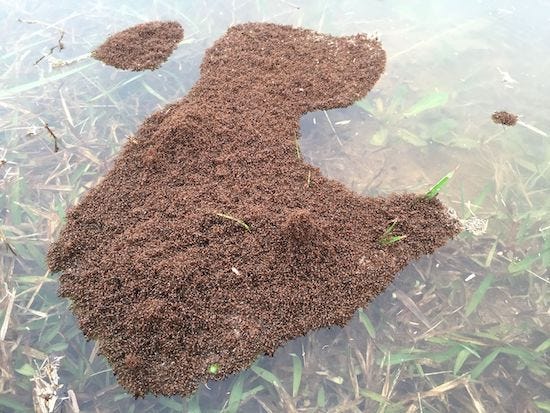
Since then, the fire ant has spread like wildfire. As nypost.com reports, not even Texas’ biblical floods can stop them. Texans shaken as thousands of fire ants seen forming rafts on river using their bodies
Thousands of fire ants have been spotted floating on floodwaters through [Austin] forming rafts using their bodies with residents now reporting the gross behavior..
When their underground nests flood, they sink their teeth into each other, interlock their limbs and create rafts to stay alive.
Nathan's Hot Dog Eating Contest is gross behavior. A commentator on X offered a more accurate description of the fire ant rafts infesting Lake Travis, calling them “a floating ball of pure hate.”
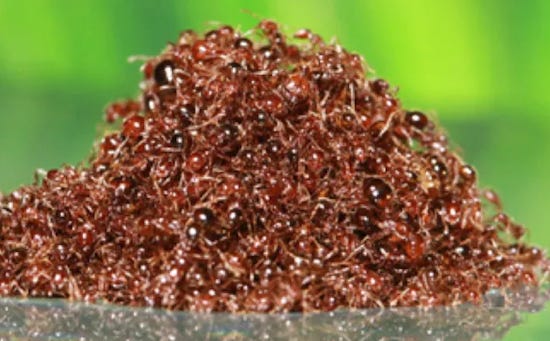
Fire ant rafts can lasts up to twelve days. The queen hangs out safely inside, with workers tossing males into the drink to drown if need be. Did I mention that fire ants are significantly more aggressive when rafting?
How Bad Is It?
Each fire ant colony is home to 100k to 250k of the little bastards, with heavily infested areas home to millions of fire ant mounds per acre.
Not that you can find the nest. There are no visible entrances; workers emerge from foraging tunnels away from their demonic domicile.
Every year, fire ants sting an estimated 14 million Americans. The number of bites per individual isn’t known, but people keeping track of such things reckon up to six percent of victims experience anaphylaxis.
That ain’t no party, that ain’t no disco. The CDC reckons the notoriously aggressive insects have killed some 80 anaphylactic Americans since the Alabamian immigrants redefined the term Crimson Tide.
You can now get bitten by fire ants in 13 mostly southern States, rapidly expanding westward.
Outside the Land of the Free, they’re everywhere, man. Australia, India, the Philippines, the Caribbean, China – anywhere that’s not too cold where the sun shines.
(Thank God for Tennessee winters. And cursed be us who are red-green color blind.)
In their defense…

Animal lovers have a ready-made excuse for dangerous animals: they have an important role to play in the ecosystem. (The animals, not bear huggers.) Yes well…
The Global Invasive Species Database lists the omnivorous fire ant as one the 100 World's Worst Invasive Alien Species. Wikipedia tells the tale.
The ant is viewed as a notorious pest, causing billions of dollars in damage annually and impacting wildlife. The ants thrive in urban areas, so their presence may deter outdoor activities.
Nests can be built under structures such as pavements and foundations, which may cause structural problems, or cause them to collapse. Not only can they damage or destroy structures, but red imported fire ants also can damage equipment and infrastructure and impact business, land, and property values. In agriculture, they can damage crops and machinery, and threaten pastures.
They are known to invade a wide variety of crops, and mounds built on farmland may prevent harvesting. They also pose a threat to animals and livestock, capable of inflicting serious injury or killing them, especially young, weak, or sick animals.
Despite this, they may be beneficial because they consume common pest insects on crops.
“May be beneficial.” Couldn’t help themselves, could they?
But you can help yourself if you live in fire ant-territory by never, ever wearing sandals, going barefoot or going for a non-proverbial roll in the hay.
You have been warned.